Build guide
How to build a DIY golf simulator, and what it costs
A golf simulator is six purchases that constrain each other, and most build guides list them in the wrong order. Golf Sim Oracle walks them in the order each one decides the next, prices three complete builds from live Amazon listings, and adds the software subscription that every other guide leaves off the bill.
Home$363.47
Cheapest complete build, today
$5,434.94
Dearest build priced here, today
9 of 24
launch monitors publish a ceiling height
Golf Sim Oracle prices 3 complete DIY golf simulator builds from live Amazon listings, refreshed every three hours. The cheapest, a launch monitor with a mat and a net and no projection, is $363.47 today. The dearest build priced here, with an impact screen and a short-throw projector, is $5,434.94. Adding the software subscription each launch monitor needs, the 5-year totals run from $3,618.40 to $6,034.34. The room decides which of these is possible before the budget does. Of the 24 launch monitors from 12 makers that Golf Sim Oracle has sourced, 9 publish a minimum ceiling height and 15 publish neither a room length nor a width, so most units cannot be checked against a measured room from the maker's own specification. Golf Sim Oracle could not find another build guide that prices the parts from live listings and adds the subscription, which is why two builds with the same hardware price can differ by thousands of dollars over 5 years.
Hardware prices are refreshed every three hours. Room figures and software prices are quoted from each maker's own site, read on the date shown beside them. Copy reviewed 2026-09-06.
The build, in the order each part decides the next
Most guides start with the enclosure. Start with the room, then the launch monitor, because those two rule out everything that follows. The listing beside each step is the one the middle build below uses today.
Step 1
Measure the room before you price anything
Ceiling height, depth from the tee to the back wall, and width. A radar launch monitor sits several feet behind the ball and needs that depth on top of the distance to the screen. A camera unit sits beside the ball and does not. Most makers publish no room figure at all, so the table on the ceiling-height page is the only way to check a unit against a measured room.
5 of 24
makers publish both a minimum room length and a width
Step 2
Choose the launch monitor
This is the part that decides the rest. It sets the depth the room needs, whether you can use a normal ball, and which software you will be paying for every year. Buy it before the enclosure, not after.
Step 3
A hitting mat
The one part of the build you hit every shot from. Thickness and turf type are what the listings state most often; whether the mat takes a tee is what they most often leave out.
1 of 12
hitting mat listings tracked here state turf pile height. The rest do not say, which is not the same as the product lacking it
Step 4
A net, or an enclosure if you will project
A practice net stops the ball. An enclosure stops it and holds a screen, so it is the frame the projector build hangs off. The specification that matters is the ball speed the net is rated for, and most listings do not state one.
7 of 24
net or enclosure listings tracked here state ball-speed rating. The rest do not say, which is not the same as the product lacking it
Step 5
An impact screen, if you will project
Skip this and the projector for a net build. For a simulator, the screen is what the ball hits and what the picture lands on, and the figure that decides picture quality is projector gain, which no listing here states.
0 of 12
impact screen listings tracked here state projector gain. The rest do not say, which is not the same as the product lacking it
Step 6
A short-throw projector
Throw ratio decides whether the projector can fill the screen from inside the enclosure without the golfer casting a shadow on it. It is the one figure to check before buying, and fewer than half the listings state it.
4 of 14
projector listings tracked here state native resolution. The rest do not say, which is not the same as the product lacking it
Step 7
The software, every year
The launch monitor you chose in step two decides this bill. Some units play courses on a free tier, some need a paid subscription from the maker, and some need two: GSPro plus the maker tier it requires first. This is the cost that turns two builds with the same hardware price into two different five-year totals.
$749
a year to play courses in GSPro on a Bushnell Launch Pro i: GSPro at $250 plus the Foresight FSX Gold tier it requires at $499


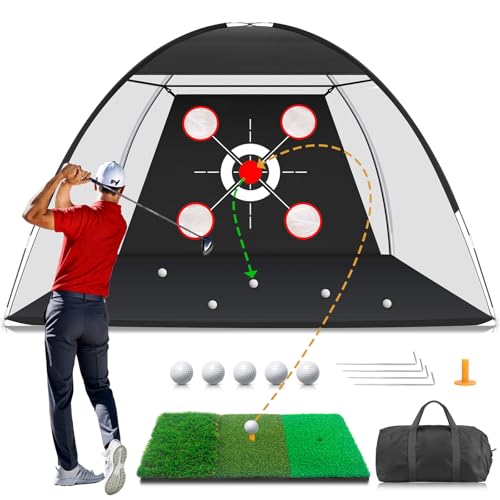

Three DIY builds, priced from live listings
Cheapest in-stock listing in each category for the first two builds, Amazon's best-placed listing for the third. Every line is a listing you can buy today, and every total adds the software that launch monitor needs each year. Prices refresh every three hours.
We may earn a commission from these links, at no extra cost to you.


Hit into a net. The cheapest launch monitor this site reviews, something to hit off and something to hit into. No projection, so the numbers come up on a phone or tablet. This monitor’s maker publishes no price for software that plays courses, so the running cost cannot be totalled here.
Project onto a screen. A mid-priced monitor plus an impact screen and a short-throw projector. This is the point at which it stops being a practice net and starts being a simulator. SkyTrak Core: Foresight, the cheapest published route to course play on this monitor.
The dearest unit we cover. The most expensive launch monitor on this site, with the component in each category that Amazon places highest rather than the cheapest. The ordering is Amazon’s own; we rank nothing. Garmin Golf Garmin Golf membership, the cheapest published route to course play on this monitor.
One listing for each part of the build
Amazon's best-placed in-stock listing in each category right now. The order is Amazon's, not ours.
We may earn a commission from these links, at no extra cost to you.

PRGR
PRGR HS 130-A Portable Golf Launch Monitor
#21 in its Amazon category
$200$230Save $30
Check price on AmazonImage: Amazon

Fanshaw
Fanshaw Premium Dual Golf Mat 5x4FT 40mm Thickened for Practice
#3 in its Amazon category
$84
Check price on AmazonImage: Amazon

KLAODOT
KLAODOT Golf Net with Practice Mat
#1 in its Amazon category
$59
Check price on AmazonImage: Amazon

Joogto
Joogto Golf Simulator Impact Screen
#96 in its Amazon category
$50$60Save $10
Check price on AmazonImage: Amazon
Where each launch monitor sits, in the maker's words
This is the line that decides whether a garage or a basement works. A unit behind the ball needs that distance on top of the run to the screen; a unit beside the ball does not. 3 of these 5 makers also state a total depth.
What makers say about the room in generalGuidance printed before any model is named, quoted as published
Questions builders ask
How much does it cost to build a DIY golf simulator?
What is the cheapest golf simulator setup?
How high does the ceiling need to be for a golf simulator?
Can you put a golf simulator in a garage?
Before you order any of it
The calculator takes a ceiling height, a depth and a width and returns the launch monitors whose makers say they fit. It is the only step here that cannot be undone by a return label.